Time, Borrowed and Well Spent

The grandkids call me NoNo.

On the beach I do the T Rex walk — little arms, big stomping, the whole production — until somebody falls over laughing. There's ice cream on the first day of school and the last day of school, every year, no exceptions. I read picture books out loud to anybody's kids who'll sit still for one.

I also have leukemia, and I'm not cured. I've got time, and nobody will tell me how much of it. So I'm spending it.

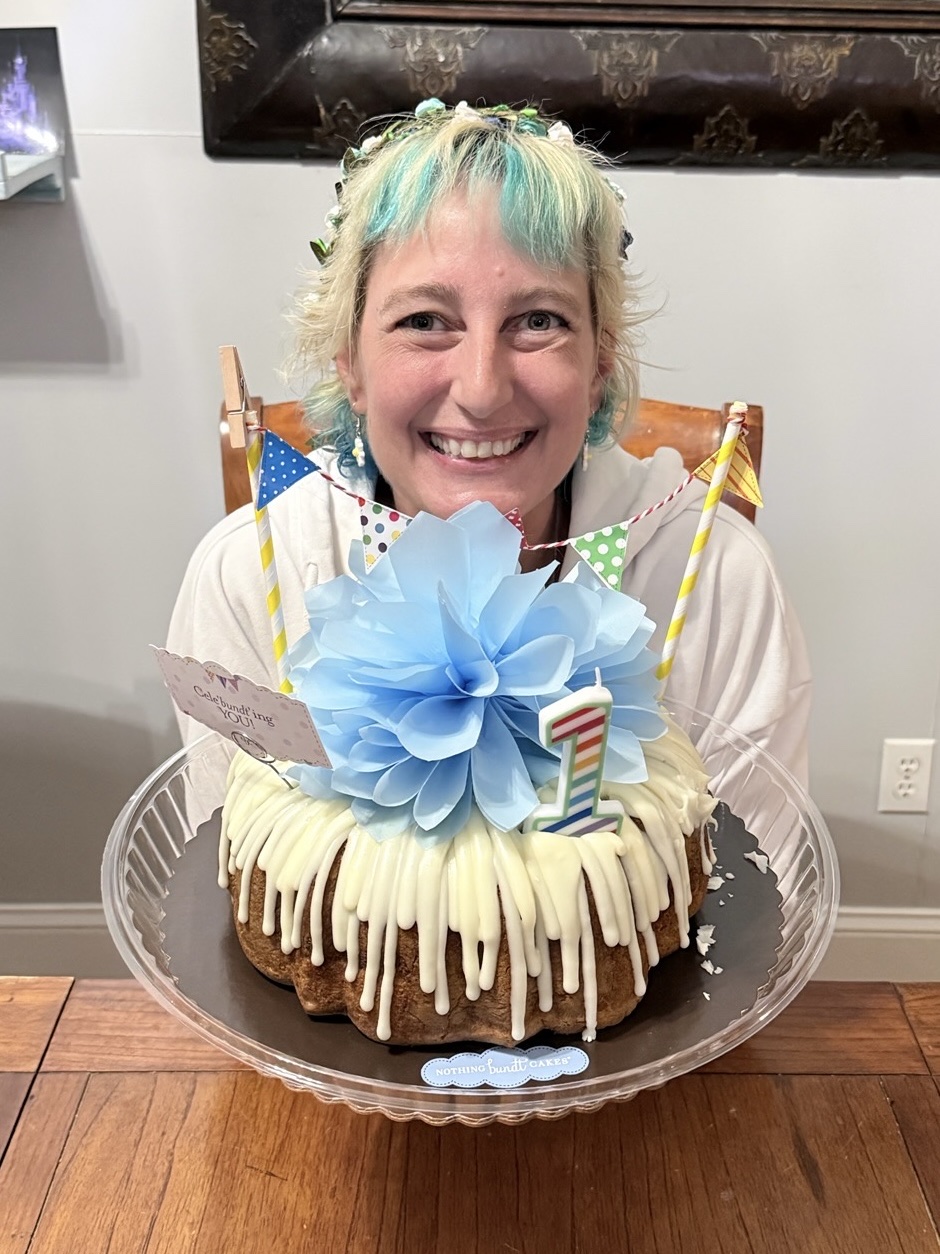
Danell in a flower crown behind a bundt cake with a number one candle, grinning, one year after her transplant
— One year to the day. Cake bundt’ing me, apparently.
Day 365

In my own words

One year to the day since the transplant. Three minutes on where things actually stand, and what I'm asking for.

Watch on YouTube · direct video file

Filmed on the transplant unit, one year after receiving a stranger's stem cells.

Start Here

Wherever you are, there’s a door

Newly diagnosed, caring for someone, further down your own road, or just wanting to help — pick whichever one sounds most like you today.

My Story

The two-point-four

Some numbers I don't forget.

“There is never a normal day around her — everything is special.”

— Mikala, one of my bonus kids
01

January 2025

After weeks of unexplained illness, my hemoglobin came back at 2.4. Normal for a woman is around 12. Nurses who had worked that floor for years told me they had never seen anyone walk in at that number — and I had walked in.

It was also my grandson Jaxon's birthday. I called him from the room and sang to him anyway, because you don't skip that.

(2.4 is the number that hit the family group chat that day. My actual chart says 2.7. Either way, not a number you want next to your name.)

“She got diagnosed on Jaxon’s birthday, but she didn’t miss calling him to sing to him.”

— Mikala, one of my bonus kids
02

Chemo & the search

Five weeks of inpatient induction chemo brought remission. Months of maintenance treatment followed while doctors searched for a stem cell donor for me — including one match that fell through at the last minute.

03

August 2025 — Transplant

A second donor turned out to be a rare 12-out-of-12 match. I spent nearly four months in the hospital and came through the critical 100-day window with minimal complications.

04

Right now

I'm in remission, living with rheumatoid arthritis from the chemo, and racing the clock to live fully in the time I've been given — while helping others just starting this same fight.
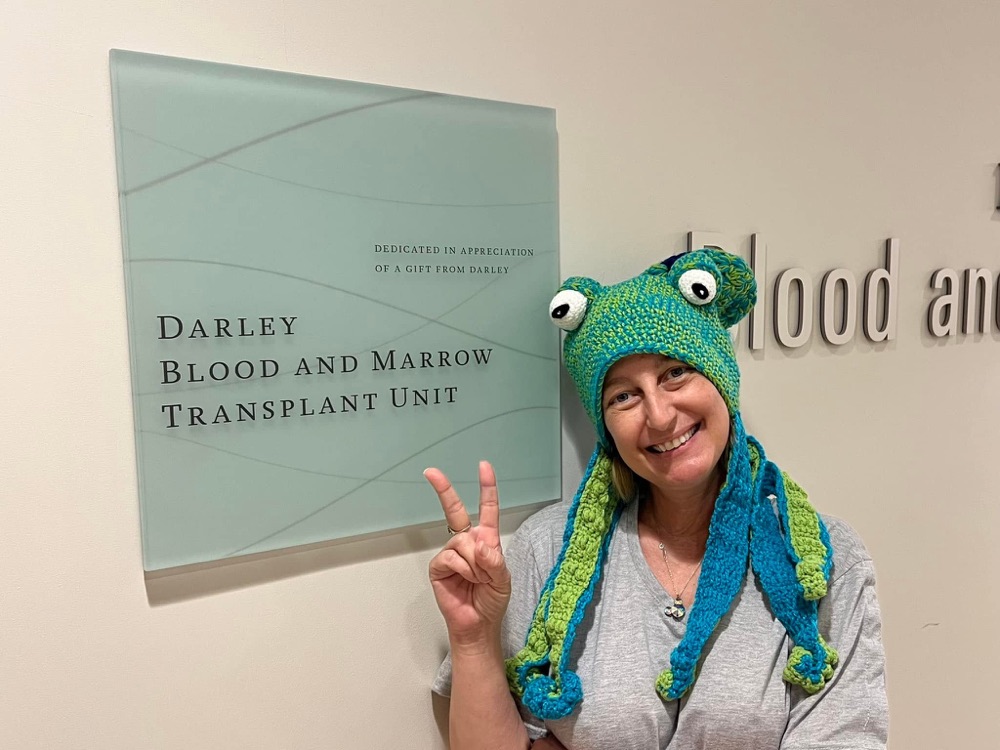
Danell giving a peace sign in a frog hat next to the Blood and Marrow Transplant Unit sign
During treatment, before my transplant
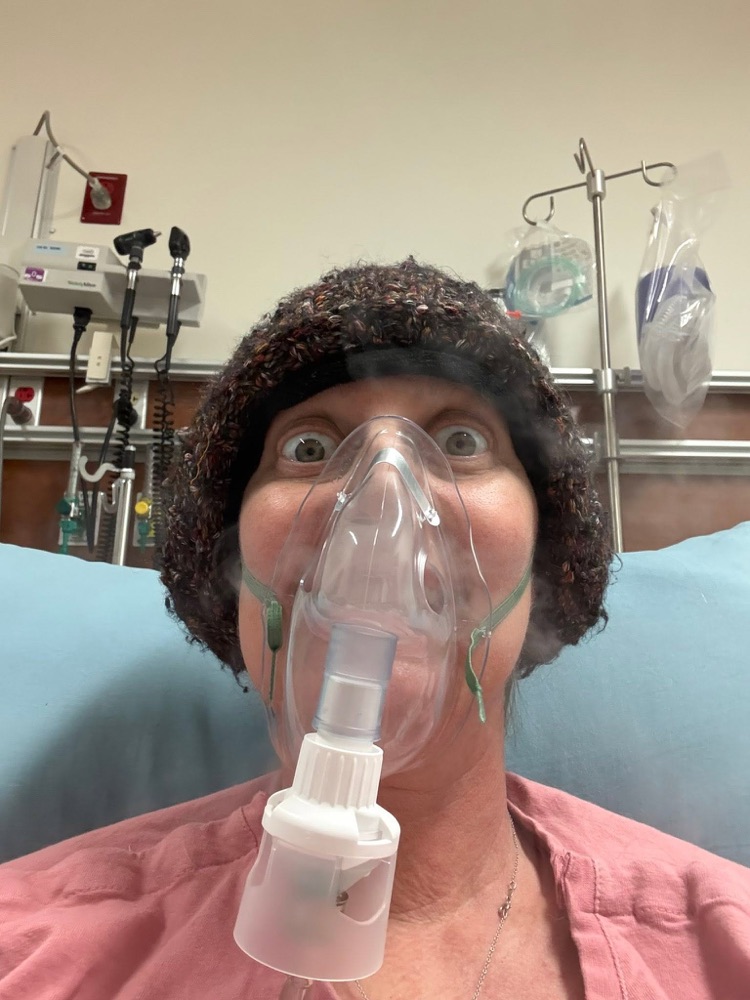
Danell making a silly face with an oxygen mask on in her hospital bed
Still fully myself, even here

Remission is not the same as being cured. My leukemia carries higher-risk mutations, and with AML, most relapses after transplant happen within the first two years. In January 2025 I was days from a coma. I know exactly how fast this can move.

So this isn't a victory lap. It's real, uncertain time, and we've decided not to sit around waiting to find out how much of it there is.

I post the bad days too. There's a photo of me on the transplant unit in a frog hat, and one of me pulling a face in an oxygen mask. I've really been through it, and I'm still laughing — that's the part I want other patients to see.

And if I can't be here in person someday, I'd like to still be here in some way — in a book read out loud to somebody's kid at bedtime. That's what Aunt Nell's Friends is for.

Most of the people who find me on TikTok are just starting the road I've already walked. So I tell them what's coming, what helped me, and what I wish someone had told me.

So we're doing it all now. Everything we can, while I can. If the remission lasts longer than expected, no one will regret having lived fully in the meantime — and we'll be the first to stop asking for help. But most of what we do together right now is likely the only time, or the last time, I get to live it. That's why the timing on the things below actually matters.
My Legacy Project

Aunt Nell's Friends

Join me as I discover our world through play and stories. I am a mom, a grandma, and an aunt to many more. They may not all be my DNA, but they are all family in my heart.

There are Happy Meals and Pokémon cards. There's a Taylor Swift song on in the car. There are Legos all over the floor and I am usually the one on the floor with them. Some of my favourite moments in this whole life have been reading bedtime stories to our grandkids and watching their faces while the book comes alive in front of them.

On my YouTube channel, I read picture books, color, and play outdoors with kids — building something joyful and educational. This is my legacy project: I want to keep giving to kids and keep showing up for their imaginations. Come be on the floor with the Legos.

Watch on YouTube

Recent read-alongs

Storytime, coloring, and outdoor adventures — new episodes going up as I make them.

See every episode on YouTube →

The Ask

What I'm hoping for

Eighteen months ago I’d have told you most of this was silly. I’ve since revised my position on silly things.

For a while I said “beaches and a few new places,” which was true but vague. Here is the actual list, because I’d rather be specific than polite. Three parks, one window. Below that are the three ways to help that make the most difference, and everything else is one click away.

The one I want most

Walt Disney World

Eight to ten of us · 7 nights

All of us in one place at one time — kids, bonus kids, grandkids. Not because it’s Disney. Because it’s everybody, together, while I’m well enough to keep up with them.

~$21,000
Going back properly

Disneyland Paris & Paris

Austin and me · 7 nights

Austin was there for work a few years ago and I flew out for the last few days. We got one afternoon in the park. I want to go back and do it properly — a few days there for World of Frozen, which opened this year, and a few days in Paris itself. A week, not an afternoon.

~$8,000
The ridiculous one

Tokyo Disneyland

Austin and me · 8 nights

I’ve wanted to see it since I was a kid. I’m not going to pretend that’s a serious reason. I’m going anyway.

~$10,500

Those are researched numbers, not round ones. A good chunk of the difference between the cheap version and the one above is medical rather than fancy — a seat I can actually sit in for fourteen hours, a room at the gates so I can sleep at 2pm and come back out for the fireworks, and the paid line-skip passes, because Disney World’s disability program doesn’t cover someone like me. The difference between “she went” and “she enjoyed it” is about five thousand dollars, and it’s the five thousand that matters.

“Nobody — and I mean NOBODY — could have fought cancer the way she did, and is still doing.”

— Mikala, one of my bonus kids
Fastest Way to Help

Give directly

Every dollar goes straight toward flights, hotels, and the everyday cost of actually getting me somewhere new.

Give via GoFundMe →
Anything Helps

Miles, points & a place to stay

Airline miles, hotel points, a timeshare week, a beach house sitting empty for a weekend — that's exactly the kind of help that gets me somewhere new. I wrote a short guide, because every program does it differently and most of them charge you for the privilege.

Read the gifting guide →
Simple & Free

Watch, share, subscribe

The easiest way to help Aunt Nell's Friends grow is to watch an episode with a kid in your life, and share it with a friend who might need it too.

Visit the channel →
Everything Else

A few other things people have asked about

A birthday cruise in March 2027, company sponsorship, nonprofit partnership, and two wish lists — one for the kids' channel, one that is frankly just for me.

See the rest →

“She never lost sight of who she was.”

— Mikala, one of my bonus kids
Hope

The uncertain math cuts both ways

Higher risk isn't a guarantee. People survive this — years past the point I'm at now, living full lives. Here's some of the real proof, and where treatment stands right now.

···

AML clinical trials actively recruiting patients right now — updated automatically.

See the current trials on ClinicalTrials.gov →
30 Years Out

"Now, 30 years later, I'm still around"

A real AML survivor's own account of his transplant, decades of life since, and watching his kids grow up. Read it when you need proof this can be a long game.

Read his story →
Real Stories

The Patient Story: AML survivors

A growing collection of real AML patients — diagnosis, treatment, transplant, and life after — told in their own words.

Browse the stories →
Real Stories

NBMT Link: transplant stories

Bone marrow and stem cell transplant survivor stories, including patients many years out and now supporting others coming up behind them.

Browse the stories →
Right Here

Stories from this community

Survivors are sharing their own stories right on this site — read them, or add yours.

See the Story Wall →
The Best Way to Help

Join the registry that saved my life

My donor was a stranger — a 12-out-of-12 match, found through NMDP (formerly Be The Match), the registry that connects patients like me with people willing to give blood stem cells. About 70% of patients who need a transplant can't find a match in their own family. Someone on that registry was my match. You could be someone else's.

Join the NMDP Registry →
1

Register online at nmdp.org — a few minutes, a few questions about your health.

2

A free swab kit arrives at your door in 3–7 days. No cost, ever.

3

Swab your cheek at your kitchen table, mail it back in the prepaid envelope. That's it — you're on the registry.

Why It Matters Who Signs Up

My match was easy to find. For a lot of people it isn't.

I am white, and a 12-out-of-12 match turned up for me. That is not most people's experience, and the reason is not medical bad luck — it is who is on the list.

Tissue type is inherited in blocks, and those blocks run along ancestry. So your best chance of a match is someone with a background like yours. When a registry is overwhelmingly one ethnicity, everyone else is searching a much smaller pool. Modelling of the US registry put the odds of a fully matched unrelated donor like this:

White patients 79%
Hispanic patients 48%
Black patients 29%

Odds of a fully matched (8/8) unrelated donor, modelled from the US registry as it stood at the end of 2020, published 2023. NMDP no longer leads with these figures — and the reason why is genuinely good news, below. Roughly 78% of the registry's effective donor pool is white; about 4% is Black.

The honest update: almost nobody is told “there is no donor” any more

Half-matched family donors and mismatched unrelated donors, combined with a drug given after transplant that tames the immune reaction, have changed this. Today more than 99% of patients have access to a donor, whatever their ancestry. If you are searching right now, that is the number to hold onto.

But the options are not equal, and I would rather say so. In one large analysis of AML patients, three-year survival was 68.5% with a young fully-matched unrelated donor and 50.8% with a half-matched relative. So a more diverse registry no longer decides whether you get a transplant. It decides whether you get the best one.

There is one more number worth sitting with. Researchers ran the maths on what full recruitment would achieve: even if every single eligible Black donor in America joined the registry and was reachable when called, the odds of a full match would rise from 29% to about 64%. Still not parity. That is not a reason to skip it — it is the reason both things have to happen at once: more people signing up, and the science that makes imperfect matches work.

If you are Black, Hispanic, Asian, Indigenous, or of mixed ancestry, you are, quite literally, the scarce thing. Someone is searching for a person with your background right now.

Who Can Join

18 to 35, and it stays free forever

You join between 18 and 35 and stay listed until 61. Doctors ask for donors aged 18–30 about 70% of the time, because younger donors measurably improve survival. It costs nothing to join, nothing to donate, and donors are never paid.

Order a free swab kit →
What Donating Is Really Like

Nine times in ten, no surgery at all

About 90% of donations are done through the arm, like giving plasma — a few days of injections that make you ache like flu, then one session of 4 to 8 hours. Median recovery is about a week. The other 10% is a marrow collection under anaesthetic, from the back of the pelvis, never the spine. Serious complications are under 1% either way.

Myths and facts →
If You Get The Call

It costs you nothing but time

NMDP covers travel, hotels, meals, childcare, pet boarding and lost wages — for you and a companion. About 20 to 30 hours spread over four to six weeks. Three quarters of patients have no match in their own family, so the person on the other end has no other option.

Why ancestry matters →
Sign the Wall

Share your story

If you're an AML or transplant survivor — one year out, ten years out, however far — I'd love for you to leave your story here. Every submission is read by me personally before it goes up, so take your time.

Not Alone

Starting your own journey?

I mentor others going through AML and stem cell transplants. If that's you, or someone you love, I'd genuinely like to hear from you.

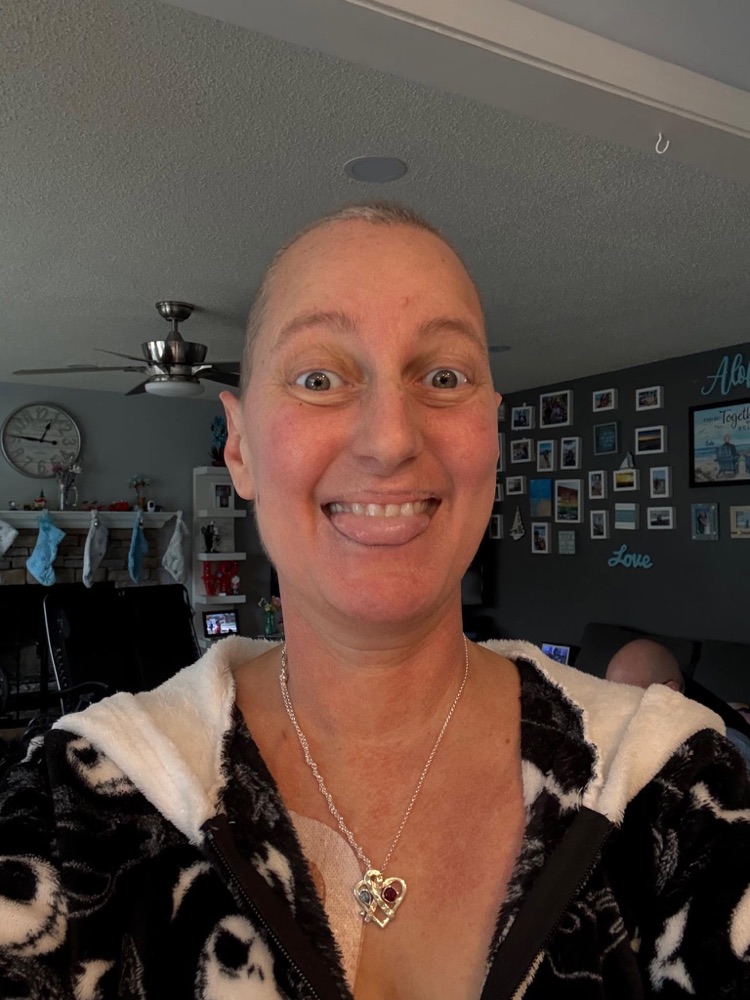
Danell making a funny face with an oxygen mask on during treatment
I've really been through it — and I'm still laughing.

Reach out on TikTok

I share my ongoing journey and connect with patients at every stage — from diagnosis to years out.

@nellyhill77 →

Follow along on Facebook

I've shared even more of my story there — day-to-day updates, the harder days included.

facebook.com/nellyhill →

Send a message

Prefer email? Reach the family directly and we'll pass it along.

hello@nellyslegacyproject.com →
You are not the first

Find your people

If you were just diagnosed with AML, or you are caring for someone who was, the loneliest part is thinking nobody has stood exactly where you are standing. Somebody has. These four will connect you with them, and none of them costs anything.

Free one-to-one matching

Imerman Angels

They pair you with someone who had your cancer, your age, your situation, and came out the other side. Not a group. One person who gets it. Free, and they match caregivers too.

Go to Imerman Angels →
Transplant-specific

BMT InfoNet

The deepest library anywhere on transplant and CAR-T, plus a directory for finding support near you. This is where I send people who want to actually understand what is about to happen.

Go to BMT InfoNet →
Free professional counseling

CancerCare

Real oncology social workers, at no cost, by phone or video. They run caregiver groups too, which almost nobody does. If you are the one holding everything together, this one is for you.

Go to CancerCare →
Peer connection

Blood Cancer United

Formerly the Leukemia & Lymphoma Society. Peer programs, financial navigation, and information specialists you can actually call.

Go to Blood Cancer United →
Gratitude

The people and places in this story

Every one of these had a hand in my still being here, or in what I know now.